
Stock Market
Live WireMilky Mist Dairy Food shares already surged 113% from IPO price in 2 months but Nuvama sees more returns; target price
This is worth watching because it affects how founders, investors, and operators read the next business cycle.
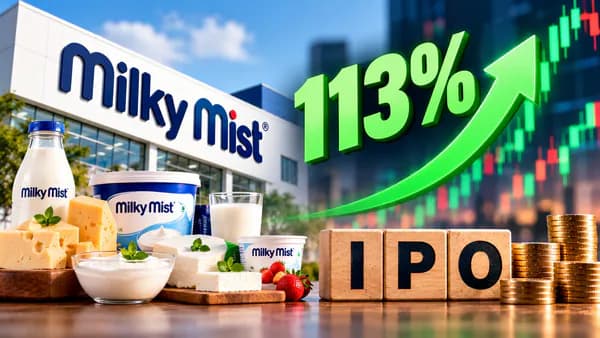
Milky Mist shares surge 113% from IPO price in 2 months(Photo: AI generated )AI Quick ReadMilky Mist Dairy Food shares were locked in the 5% upper circuit at ₹298.75 apiece on the BSE on Tuesday, 27 October, taking the stock’s gains to 113% over its initial public offering (IPO) price in just over two months.
Against this backdrop, Nuvama Institutional Equities has initiated coverage on Milky Mist Dairy Food with a ‘Buy’ rating and a target price of ₹330, citing the company’s strong growth outlook, premium value-added dairy portfolio and improving cash flows as it transitions from a phase of heavy capital expenditure to a period of stronger returns.
Nuvama believes the stock could continue to command a premium valuation, supported by its growth profile and focus on value-added dairy products (VADP). The brokerage has valued the company at 50 times its estimated September 2028 earnings per share (EPS), a premium to peers.
The brokerage expects Milky Mist to deliver a compound annual growth rate (CAGR) of 27% in revenue, 35% in EBITDA and 57% in earnings per share over FY26–FY29. Growth is expected to be driven by its core categories of paneer, cheese and curd, expansion in yoghurt and ice cream, and a wider geographical presence beyond South India.
However, Nuvama flagged risks arising from milk price volatility and the company’s geographical and manufacturing concentration. Around 95% of its milk procurement comes from Tamil Nadu, while approximately 69% of sales are generated in South India. The company also relies on a single plant, making operational concentration a key risk.
Nuvama described Milky Mist as India’s only pure-play value-added dairy company and a high-growth consumer business. The company’s revenue grew at a CAGR of 31% between FY24 and FY26, while EBITDA expanded at a 41% CAGR. In the first quarter of FY27, revenue increased 43.6% year-on-year, accompanied by a 275-basis-point improvement in gross margin.
Milky Mist has a portfolio spanning more than 20 categories, entirely focused on value-added dairy products, with no liquid milk business. According to Nuvama, the company is the largest private packaged brand in paneer, with around 19% of the organised market, and holds approximately 12% of the South Indian cheese market. It is also among the top two private packaged yoghurt brands, with a market share of about 13%.
The brokerage sees further growth opportunities in protein-rich categories such as curd, paneer, cheese and whey, where demand is supported by increasing consumer interest in higher-protein foods.
Nuvama estimates that paneer, cheese and curd account for approximately 60% of Milky Mist’s revenue and expects these categories to grow at a combined CAGR of around 28% over FY26–FY29.
Paneer, which contributes approximately 30% of revenue, is expected to grow at a CAGR of 29%. The brokerage believes the shift towards organised players, supported by restrictions on analogue paneer and zero GST, could benefit the company.
Cheese revenue is projected to grow at a CAGR of 29%, aided by capacity expansion in cheddar, while curd is expected to record a 24% CAGR over the same period.
Nuvama expects yoghurt and ice cream to grow at CAGRs of 45% and 35%, respectively, over FY26–FY29. Their combined contribution to revenue is projected to increase from 13% to 17%.
The brokerage highlighted Greek yoghurt and Skyr as key products in Milky Mist’s premium, high-protein portfolio. Capacity expansion in yoghurt is expected to support the company’s plans to scale these categories.
50,000-plus coolers and freezers to support expansion beyond South India
Milky Mist plans to deploy more than 50,000 coolers and freezers over the next three years, compared with an existing base of approximately 41,000. Nuvama believes this investment will help improve product availability and strengthen distribution in markets beyond South India.
Sourced from KnowledgeLoop