
Stock Market
Live WireCan a husband gift cash to his wife without triggering a tax demand? ITAT examines ₹58 lakh bank deposits
This is worth watching because it affects how founders, investors, and operators read the next business cycle.
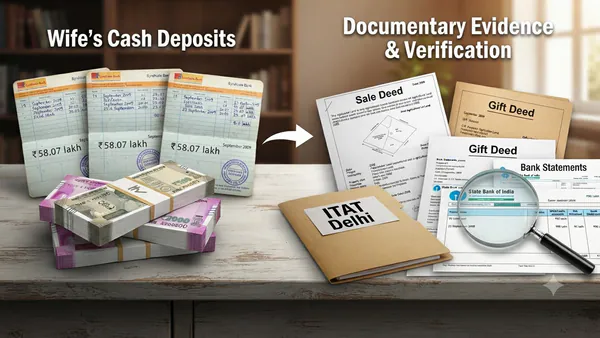
The taxpayer argued that the source of the larger deposits was cash withdrawn by her husband, Mahabir, from his State Bank of India (SBI) account. (AI-generated image used for representational purpose.)AI Quick ReadCan a woman's bank deposits be treated as unexplained income if she claims the money came from her husband's bank withdrawals? The Income Tax Appellate Tribunal (ITAT), Delhi, has directed the tax department to verify such a claim by examining the couple's bank records, the sale of agricultural land and a gift deed.
The ruling in Sunita vs Income Tax Officer, pronounced on 18 November 2026, concerns ₹58.07 lakh deposited by the woman across three bank accounts during September 2009. The assessing officer had treated the entire amount as unexplained money under Section 69A of the Income-tax Act, 1961.
The tribunal admitted additional evidence, including the land sale deed, bank statements and gift deed, and sent the matter back to the assessing officer for limited verification. It has not, however, deleted the ₹58.07 lakh addition or given the taxpayer a final clean chit.
The woman maintained three bank accounts with Syndicate Bank. According to the details submitted before the tribunal, she deposited ₹18 lakh on 23 September 2009 and another ₹40.02 lakh on 24 September 2009. She had also deposited ₹5,000 on 19 September 2009 while opening one of the accounts.
The money was subsequently used to create fixed deposits worth ₹58 lakh with the bank.
The taxpayer argued that the source of the larger deposits was cash withdrawn by her husband, Mahabir, from his State Bank of India (SBI) account. He had withdrawn ₹90 lakh on 23 September 2009, and his bank account was closed the following day.
She also explained the source of her husband's funds. He had sold agricultural land jointly owned with his brother at Bakkarwala village in Delhi. The land, measuring around four acres, was sold for ₹11 crore through a registered sale deed dated 4 April 2008.
Her husband had received ₹3.21 crore as his share of the sale consideration, according to the documents submitted before the tribunal. The proceeds were invested in fixed deposits, which were subsequently encashed. The amount was credited to his bank account on 22 September 2009, a day before he withdrew ₹90 lakh.
The woman maintained that her husband gave her the money, which she deposited in her bank accounts.
The case originated after the tax department received information through the Annual Information Return (AIR) that the woman had deposited ₹20.01 lakh in a Syndicate Bank account but had not filed an income-tax return for assessment year 2010-11.
The assessing officer issued a reassessment notice under Section 148 on 31 March 2017. As the taxpayer did not respond to subsequent notices, the officer completed the assessment under Sections 144 and 147, relying on the available information.
After examining three bank accounts, the officer treated the total deposits of ₹58.07 lakh as unexplained money under Section 69A.
The woman challenged the addition before the Commissioner of Income Tax (Appeals), submitting the land sale deed, bank statements and a gift deed executed by her husband on 5 February 2019.
However, the appellate authority refused to admit these documents as additional evidence under Rule 46A of the Income-tax Rules because they had not been submitted during the assessment proceedings.
The woman explained that she was a homemaker from a farming family, had no educational background and lacked access to professional assistance to respond adequately during the assessment.
Sourced from KnowledgeLoop