
Stock Market
Live WireHow Nvidia stock skyrocketing 31% will change risk-return outlook for mutual funds? Experts weigh in as Jensen returns
This is worth watching because it affects how founders, investors, and operators read the next business cycle.
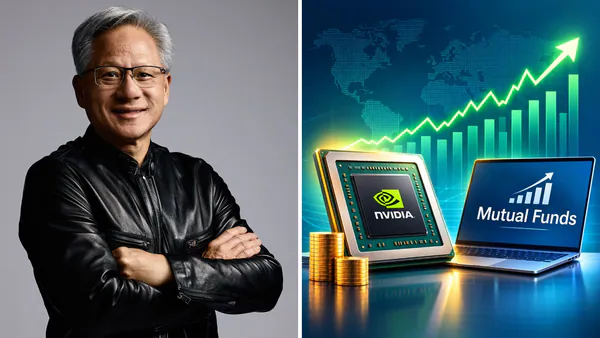
How Nvidia stock skyrocketing 31% will change risk-return outlook for mutual funds? Experts weigh in as Jensen returns. (Source: Nvidia website & AI-generated image for representational purposes only)AI Quick ReadNvidia's board unanimously reinstated Jensen Huang as president, CEO and board director on Monday, 23 November, 11 days after his resignation following reports of an extramarital affair and alleged links to a Chinese intelligence spy.
The board said its decision followed discussions with Huang and input from senior US government officials. However, its investigation into the matter will continue.
The development triggered a sharp recovery in Nvidia shares. According to Yahoo Finance, Nvidia Corporation closed at $165.05 on 23 November, up 31.48%. Currently, the stock is trading at $162.68, down 1.44% (3:46 am EST on 24 November; 2:16 pm IST on 24 November).
The sharp rebound could also influence mutual funds holding Nvidia directly or through US indices. But how much could retail investors benefit, and should they consider investing in these funds after the rally? Here's what experts say.
The list includes passive international funds such as Mirae Asset S&P 500 Top 50 ETF, Mirae Asset NYSE FANG+ ETF and Motilal Oswal NASDAQ 100 ETF, alongside actively managed schemes such as Edelweiss Technology Fund, Franklin India Technology Fund, Axis Innovation Fund and ABSL International Equity Fund.
*Source: Value Research, Allocation as on 31 October 2026, Direct plans
Rahul Jain, Director – Advisory Business & Head of Research & Products, International Money Matters (IMMPL), said, “The effect on a fund depends almost entirely on how much Nvidia it owns. At roughly 12%, the Mirae Asset S&P 500 Top 50 ETF gains close to 3.7% of NAV from the move, and the NASDAQ 100 funds, at around 8%, about 2.5%.”
For instance, a 12.12% allocation translates into a 3.82% NAV contribution. This means a potential gain of ₹3.82 for every ₹100 invested, solely from Nvidia's rally.
“For actively managed funds with allocations below 5%, particularly those near 1%, the impact would be much smaller. The rally largely recovers the sharp fall following Huang's exit, meaning investors may only be back to levels seen a few weeks ago,” he added.
Gaurav Garg, Head – Research, Lemonn, added that actual fund returns would also depend on other holdings, currency movements and portfolio changes.
Piyush Jhunjhunwala, Founder & CEO, Stockify, said Huang's return could address concerns around Nvidia's management. Despite the company's strong fundamentals, supported by semiconductor demand from the AI and data centre industries, this is unlikely to significantly affect its value. Investors should also examine the company's high market capitalisation and concerns surrounding its deputy management.
Garg said renewed optimism could support technology-focused funds, backed by AI demand and earnings growth. However, elevated valuations, competition, geopolitical restrictions and uncertainty around AI spending remain risks. Active fund managers may selectively adjust exposure based on valuations and earnings visibility, while passive funds will have to follow underlying benchmark weights.
Jain cautioned that a 30% single-session move highlights volatility in both directions. Any fresh allocation by fund managers would depend on valuations and AI-related risks, rather than leadership development alone.
Mohit Bagdi, Founding Partner & Head of Investment Research, MIRA Money, said Nvidia remains around 11% below its level at the start of the year. With investigations into financial accounting and the alleged espionage incident still pending, investors should remain cautious.
He believes fund managers may prefer booking profits during the recovery rather than adding exposure at higher levels.
Sourced from KnowledgeLoop