
Stock Market
Live WireSweep-in FD vs regular FD: 5 key differences investors should know
This is worth watching because it affects how founders, investors, and operators read the next business cycle.
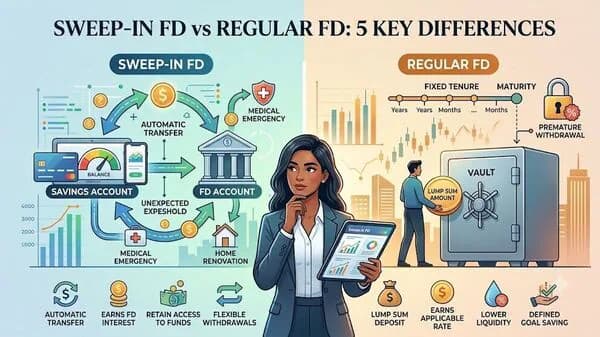
Sweep-in FDs automatically transfer surplus savings into fixed deposits, while regular FDs lock in a lump sum for a chosen tenure, offering different levels of liquidity and flexibility. (AI-generated image for representational purposes only)AI Quick ReadA sweep-in fixed deposit (FD) is an investment option that helps bank customers earn interest on surplus savings. All the while retaining access to their funds to meet unexpected expenses such as a medical emergency, unforeseen surgery, an accident, or home renovation expenses.
A regular FD, by contrast, permits investors to deposit a lump sum amount for a chosen tenure. Both these investment options can offer better returns than a savings account; still, their liquidity, withdrawal and redemption rules and interest calculations differ.
That is why, before opting to proceed with any of these options, aspiring investors should understand the basic differences between them and compare banks’ interest rates, minimum-balance requirements, and premature withdrawal conditions.
A sweep-in FD generally earns the applicable interest rate of a regular FD for the corresponding tenure. However, premature withdrawals may attract penalties or different interest calculations.
For instance, SBI’s regular FD rates broadly range from 3.05% to 6.40% p.a., depending on tenure, with sweep-in returns subject to deposit terms. Keeping these basics in mind, let us discuss the core difference between the two. Such an approach will assist aspiring investors with meaningful financial planning.
Note: The salient features and differences discussed above are illustrative. For a complete understanding of specific fixed deposits, refer to the official website of the respective lender.
State Bank of India: Investors can invest in the State Bank of India (SBI) Multi-Option Deposit Scheme (MODS). This scheme supports auto-sweep. Currently, the published minimum auto-sweep threshold is ₹50,000, with a minimum resulting savings-account balance of ₹35,000. Deposits under this start as ₹15,000 in multiples of ₹5,000, whereas reverse-sweep withdrawals are made in ₹5,000 units. The rules discussed here are illustrative and subject to change per bank policy. Hence, proper due diligence is a must before considering any investments.
HDFC Bank: Its FD terms specify that premature withdrawals, including sweep-in and partial withdrawals, may attract a 1% reduction in the applicable interest rate. These rules are not fixed; they are tentative and subject to the kind of fixed deposit invested and the bank's policies. Furthermore, linked-account balance requirements and service charges also continue to apply.
ICICI Bank: Effective 5 October 2026, ICICI Bank's fixed deposits (FDs) go up to 6.50% for general customers and 7.10% for senior citizens on eligible tenures. This is a broad range of FD rates and does not guarantee identical effective returns for every sweep-in transaction.
It is essential to keep in mind that sweep-in FDs generally follow the bank’s applicable FD rate structure, but actual returns differ when funds are withdrawn early. That is why it is wise to check each bank’s current applicable rate card and investment terms before considering any investment.
There cannot be a single answer to this question. As investments are need-based and done according to an individual’s financial reality and long-term economic objectives. The investment decision, hence, should be based on how one intends to use their funds.
A sweep-in FD may suit people who want to earn FD interest on surplus funds while retaining convenient access to cash. A regular FD may be more appropriate for money earmarked for a specific goal.
In case of doubt or hesitation, it is wise to seek help from a certified financial advisor before making any investments, as this approach ensures your investments are guided by professionals and made appropriately in line with your long-term financial objectives.
Disclaimer: This article is for general information only and should not be considered financial advice. FD rates, withdrawal rules and charges vary by bank and may change. Verify the latest terms with your bank and consult a qualified financial adviser if in doubt.
Shivam writes on personal finance, equity markets, and mutual funds. He has previously contributed to several leading publications, including Moneycontrol. He can be reached at shivam.shukla@htdigital.in
Sourced from KnowledgeLoop